
Platform comparison
How Nimbu compares
and what it means for your agency.
You are re-evaluating your platform. This is the right moment to look past feature checklists at the structural questions: where your clients' data lives, whether you will rebuild in two years, and whether one platform can replace five. Here is how Nimbu lines up, calmly and factually, against the platforms agencies are leaving in 2026.
Pick where you are coming from
Each card states the one structural difference that matters to an agency, plus one honest note on what that platform does better.
Commerce platform
Nimbu vs Shopify
Shopify is built for the brand-founder, not for an agency portfolio. Nimbu pairs real commerce with a full CMS, native multilingual, and built-in consent on EU jurisdiction, with an agency multi-site model. Honest note: Shopify's checkout, payment breadth, and app marketplace are deeper.
Headless CMS
Nimbu vs Contentful
Contentful is now a Salesforce product. Nimbu is an independent Belgian company with no acquisition overhang, CMS and commerce in one EU-native platform. Honest note: Contentful's enterprise content modeling and integration ecosystem are more mature.
Page builder
Nimbu vs Squarespace
Squarespace is excellent for a non-technical solo owner. For an agency it has no real API story, no server-side logic, no native multilingual. Nimbu gives developer control, real commerce, and a model built for many client sites. Honest note: Squarespace's design polish out of the box is hard to match for simple sites.
Visual CMS
Nimbu vs Webflow
Webflow's visual canvas is best in class for design-led teams. Real shops still bolt on Shopify, there is no native multilingual or server-side logic, and recent pricing changes made the model harder to predict. Honest note: Webflow's visual design canvas is code-free; Nimbu is code-first.
OSS commerce
Nimbu vs Medusa
Medusa gives full code ownership, zero GMV fees, and deep headless commerce. The cost: you self-host Postgres, Redis, S3, and Node, own a frontend, and stitch in your own CMS, multilingual, and consent. Honest note: Medusa gives full code ownership and zero platform fees; Nimbu is a hosted platform and does not.
Most agencies are not switching from one product
They are switching from a category. Find yours below. Each path explains what you carry over and what you stop stitching.
Coming from a commerce platform
You have real commerce but a thin CMS, a stack of paid apps, and a rebuild waiting at the next major version. Nimbu keeps the commerce depth and adds a CMS, multilingual, and consent in the same platform, without the app sprawl or the forced re-platform.
Coming from a headless CMS
Strong content modeling, but no commerce, and a separate frontend and infra you maintain. Nimbu puts CMS and commerce together, serves both Liquid themes and headless frontends from the same content model, and runs server-side logic in-platform.
Coming from a page builder
Fast to a first site, then a ceiling: limited API, no server-side logic, basic or bolt-on commerce, no native multilingual. Nimbu gives developer control without owning a frontend stack, with real commerce and i18n built in.
Coming from OSS commerce
Total control and total ownership, including Postgres, Redis, S3, Node, frontend, and a missing CMS layer. Nimbu keeps the developer control and removes the infra burden: a complete platform you ship on immediately.
Why agencies are re-evaluating right now
Three platforms changed under their agencies this year
Last reviewed: June 2026. This is not theory. None of this is meant as a dig. These are real teams, and a forced move is genuinely disruptive. But if you are on one of these, you already know why you are reading this page.
Contentful to Salesforce
The June 2026 acquisition puts jurisdiction, pricing, and roadmap under Salesforce's strategy. If you chose Contentful to stay independent of a large US platform vendor, that calculus just changed.
Payload to Figma
Payload's acquisition by Figma left teams reading the roadmap for signals about new signups and long-term direction. Uncertainty is its own cost when you are committing client sites for years.
Craft 6 to Laravel
The move to a Laravel foundation is a migration event, the kind of rebuild an agency absorbs as unplanned cost across every client on the platform.
A platform change you did not choose is the expensive kind. The point of this page is to help you choose the next one deliberately.
A structural answer your client's legal team can use
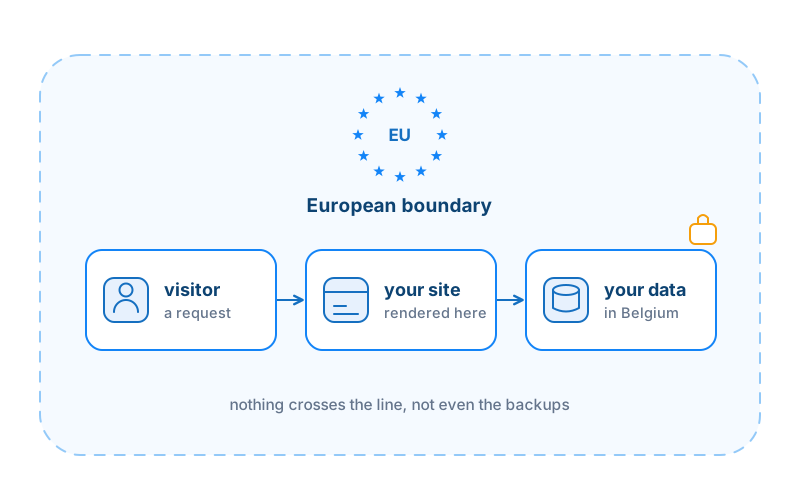
Nimbu is built and run by Zenjoy, a Belgian company under EU jurisdiction, regulated by the APD. Customer data is hosted in the EU. GDPR consent and cookie management ship inside the platform. Sensitive customer fields are encrypted at rest with keys held in the EU.
Any CMS or commerce platform incorporated in the United States is reachable by US authorities under the CLOUD Act regardless of where its servers sit. That is a fact about how those companies are organised.
- Belgian company under APD and EU law EU law is the law that applies to your client's data.
- EU-hosted customer data GDPR consent and cookie management built into the platform.
- Encrypted fields with EU-held keys Field-level, part of the Custom Field model.
The whole platform is programmable
An agent drives the real thing end to end. Nimbu is API-first with 200+ documented endpoints, OAuth2 and OpenID Connect, and a versioned contract. The nimbu CLI ships as an open agent skill for Claude Code, GitHub Copilot, and 35+ other agents. A one-line integration. An agent can push a theme, create a product, run a Cloud Code function, and deploy a real site.
- 200+ documented REST endpoints OAuth2 and OpenID Connect, a versioned contract.
- Open agent skill for 35+ agents Claude Code, GitHub Copilot, and more. One-line integration.
- Server-side Cloud Code Functions, custom routes, scheduled jobs. No infra to own.
What is structurally different
Four things a competitor cannot copy with a setting
Features change. These four are about how Nimbu is built and who owns it.
European by construction
Belgian company, APD jurisdiction, EU-hosted data, field-level encryption with EU-held keys, and consent built into the platform. Not a setting you toggle: the company structure.
Agent-native, today
API-first, CLI-driven, server-side Cloud Code. An agent drives the real platform end to end. The nimbu CLI ships as an open skill for 35+ agents.
Complete from day one
CMS, commerce with a 13-state order machine, native multilingual with around 40 locales, Elasticsearch search, and consent. One vendor, one support queue, no stitching.
Independent
Zenjoy is bootstrapped and profitable, with no outside investors and no acquisition it is steering toward. The roadmap answers to customers. The alternatives above keep getting bought.
When the client's legal team asked where the data lived and whether it was reachable by a non-EU authority, we had a structural answer in the proposal, not a settings screenshot. That conversation changed how we pitch the platform.
Switching is the part agencies fear most
Here is the honest shape of it. Everything in Nimbu is reachable over the REST API and the CLI, which means content, products, and orders move in, and back out later, programmatically, by hand or by agent. Your data is never boxed in by what the platform decided to support.
Familiar theme layer
If your team knows Shopify Liquid, the theme layer is familiar on day one: layouts, templates, snippets, and assets, Git-versioned with no build step.
Flexible data without migrations
Content modeling is flexible without migrations. Add a Custom Field and keep moving. For a client launch, that means one platform to learn and one place to call when something needs attention.
The migration guides in the docs walk through importing content, products, and orders, mapping your content model, and porting a theme.
Not sure which comparison applies?
The fastest path is a short conversation
If you are mid-evaluation and not yet committed to a named alternative, tell us what you run now, what keeps breaking, and what a move would involve. We reply personally to schedule a 30-minute call.
Request received.
We read every request personally and will get back to you to schedule the call.
Book a demo
We reply personally to plan a 30-minute call.
Something went wrong while sending. Please try again in a moment.