
Commerce built in.
Not bolted on.
A real commerce backend in the same platform as your content. Products, variants, pricing schemes, a 13-state order machine, EU gateways, and multilingual checkout. No second platform to sync.
- 550K+
- orders processed
- 300+
- sites and shops
- 15+
- years in production
A backend that sells, not a plugin you maintain
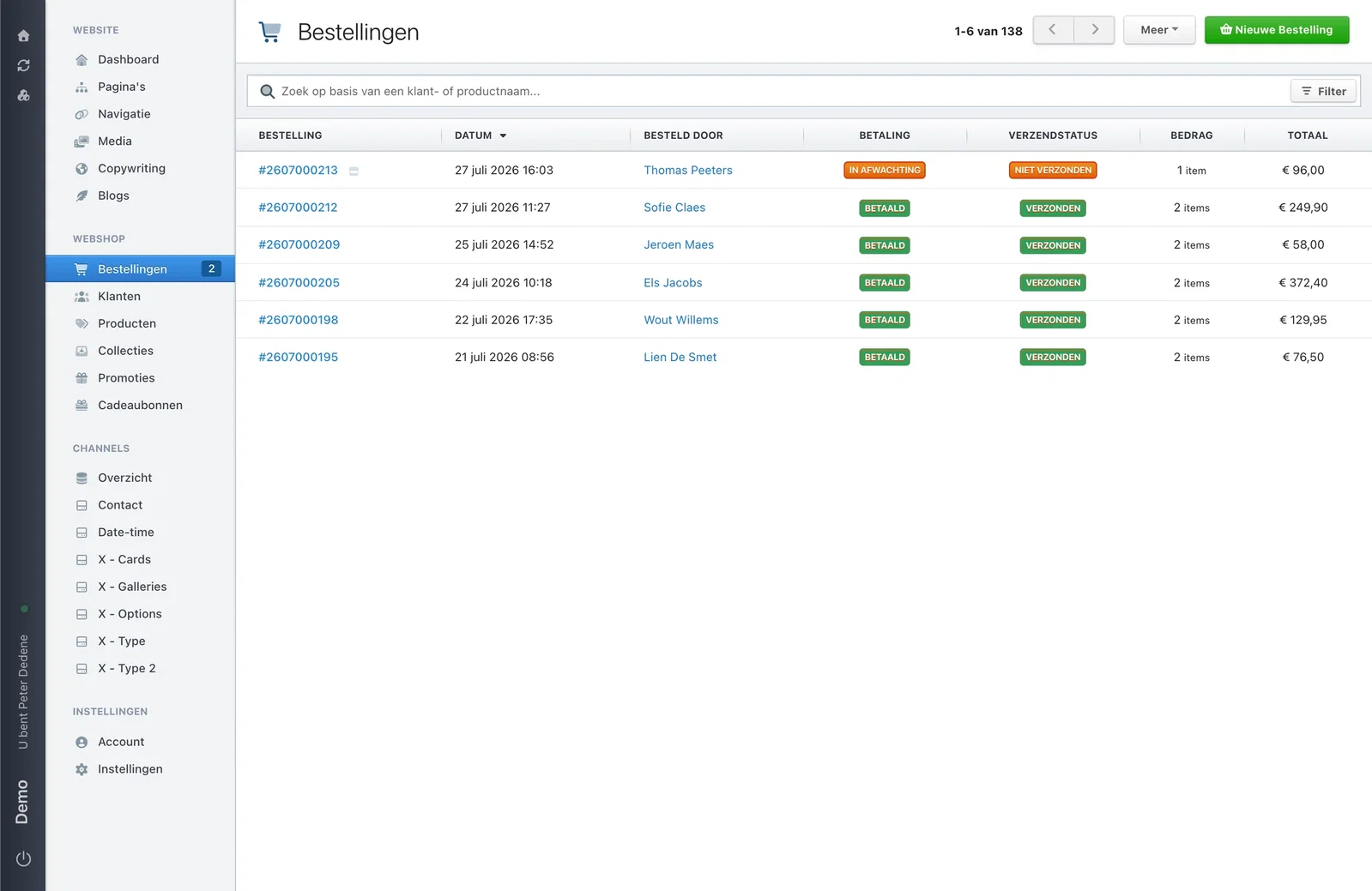
Commerce is part of the data model with the depth a real EU retailer needs from day one. Products, variants, pricing schemes, a formal 13-state order machine, coupons, gift cards with a redemption ledger, customer groups, and checkout profiles.
- Products with variants and pricing schemes Model size, colour, or any option set. Apply tier, group, or promotional pricing without duplicating products.
- 13-state order machine Formal state transitions for fulfilment, refunds, and partial states. Cloud Code and webhooks react to each step.
- Gift cards with a redemption ledger Issue gift cards and track every redemption so balances reconcile and partial spends are auditable.
One data model
Content and commerce in the same platform. No sync layer.
A page and a product live in the same platform, queried through the same Liquid Drops and the same REST API. No second system to keep in step, no second vendor, no second support queue on launch night.
- No nightly sync job A page and a product live in the same platform. No job copying data from a shop into a CMS.
- One dashboard for all client shops For an agency running many client shops, one platform to learn and one portfolio to manage.
- No drift between content and store What the content team edited and what the store sells are the same record.
Every part of the EU commerce stack, built in
One platform, one data model, one place to call when something needs attention. No app stack to assemble per client.
European payment gateways
Mollie, Stripe, MultiSafepay, PayPal, Adyen and more. First-class capabilities, not region-locked afterthoughts. Each connection needs per-site keys, which is the correct security posture.
Customer groups
Segment customers for group pricing, restricted catalogues, and B2B access rules. Use the same groups to gate views in your authenticated portals.
Coupons
Discount rules per shop: fixed, percentage, or conditional. No checkout logic to write from scratch.
Checkout profiles
Configure required fields, address handling, and the flow your client's market expects. Per shop.
Multilingual commerce
Translated products, localized pricing, and checkout across 40+ content locales. Language-aware Elasticsearch. Not a plugin.
Liquid storefront control, or headless when you want it
The same Liquid layouts, templates, snippets, and assets structure with commerce Drops exposing products, variants, the cart, and orders. Or point any frontend at the REST API. One backend, your choice of delivery.
- Liquid storefront control Products, variants, the cart, and orders directly in Liquid templates. No proprietary checkout shell you cannot shape.
- Headless when you want it Same commerce data over the REST API with OAuth2, granular scopes, and webhooks on order and product events.
- One backend, two approaches Build in Liquid, go headless, or run both against one backend. The commerce model doesn't change underneath you.
Honest comparison
Where Nimbu sits against the usual options
Each has a larger third-party ecosystem than Nimbu. If your project's value is a specific niche app from a marketplace, weigh that. If its value is shipping a reliable multilingual EU shop on one platform you don't re-stitch every client, that is the trade Nimbu is built for.
vs Shopify
Deep commerce, but the CMS and multilingual story stay thin
Shopify's commerce depth is real. The B2B and multilingual EU project needs often arrive as a paid app stack with separate vendors and bills to upgrade. Nimbu keeps commerce, content, and multilingual in one model with no app stack to assemble.
vs Medusa
Commerce only. You bring the CMS, the frontend, and the infra.
Medusa is capable open-source commerce, but it ships commerce only. You bring your own CMS, frontend, and infrastructure. Nimbu gives you commerce and content and a managed platform so there is nothing separate to integrate or stand up.
We run multiple client shops from one dashboard. No separate commerce platform to sync, and multilingual checkout worked from day one. The order machine handled partial fulfilment and refunds without any custom logic on our end.
See commerce on your own client work
Bring a shop you are scoping or rebuilding. We will show you the order machine, variants and pricing schemes, gift cards, and an EU gateway running in the same platform as the content. No separate store to sync.
Request received.
We read every request personally and will get back to you to schedule the call.
Book a demo
We reply personally to plan a 30-minute call.
Something went wrong while sending. Please try again in a moment.